Internet technologies become easier to understand when students have to connect sensors, backend services and a customer-facing interface into one working system. In the 2025/2026 winter semester, five teams in our Internet Technologies course developed warehouse-monitoring prototypes with an API and project requirements prepared by Aimtec. Generative AI supported both the student projects and our teaching materials, with transparent reporting of the tools used and an individual defence of each submitted solution.
The semester project covered the full path from a physical measurement to a customer-facing application. Students measured temperature, humidity and light conditions in a warehouse scenario, designed the sensor hardware, sent the data to a server and connected their solution to an interface specified by Aimtec. Aimtec provided the API, documentation and requirements, then participated in the project evaluation as the customer.
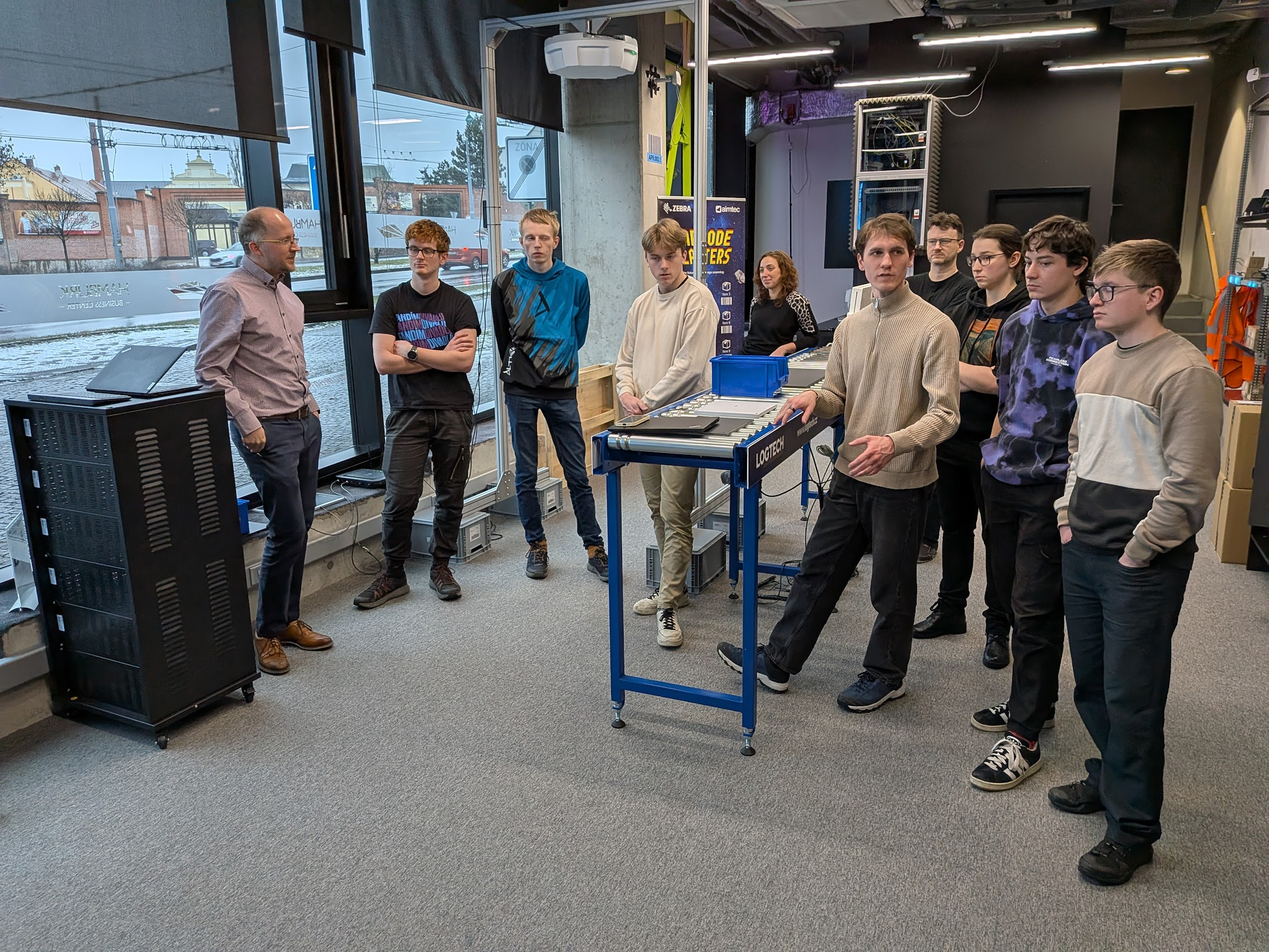
The cooperation continued after the project presentations. On Monday 26 January 2026, KKY/ITE students visited Aimtec to see the company’s working environment and examples of logistics technology. The visit connected the customer-style semester assignment with the systems and professional roles that had informed it.
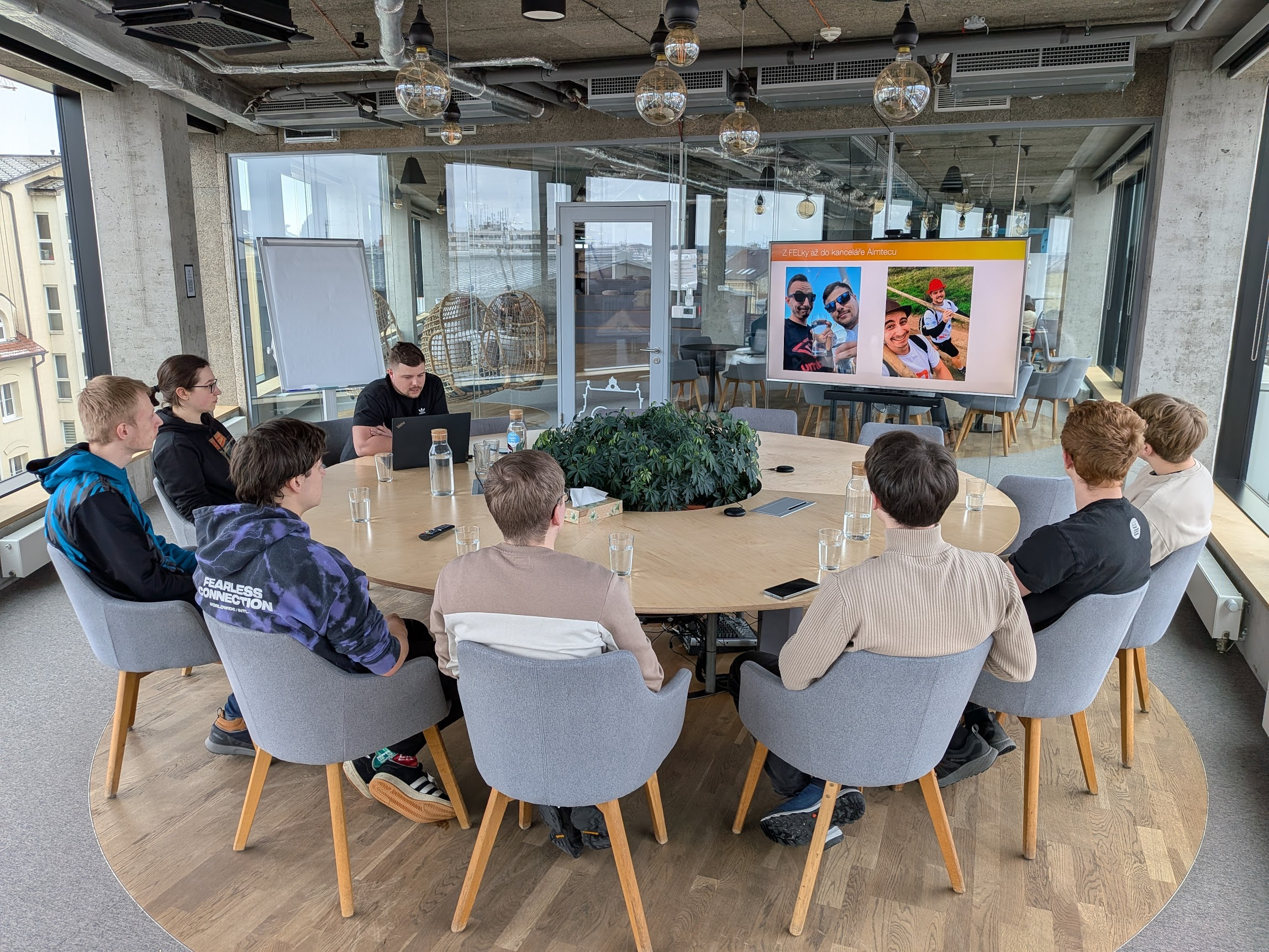
The five teams had three members each. A task of this size makes division of work visible: somebody has to take responsibility for the hardware, somebody for communication and backend services, and somebody for integration and presentation. Many students continued beyond the minimum assignment because a working prototype quickly exposes practical questions that do not appear in an isolated programming exercise.
The IoT Lab at the University of West Bohemia supported this transition from diagrams to physical devices. Its voluntary workshops introduced soldering and 3D printing. Students moved from a solderless breadboard to a durable prototype and designed an enclosure, which brought questions of assembly, access to components and actual use into the engineering discussion.
Generative AI was an accepted part of the workflow. Teams used tools including ChatGPT, Gemini and GitHub Copilot for brainstorming, code generation, debugging and presentation preparation. Their final presentations included at least one slide describing which tools they had used and how useful they had found them. The range of tools was broad, and the students’ assessments were often healthily critical.
Transparency was paired with verification. After the team presentation, each student defended the project individually with a teacher and explained the submitted solution. This short technical conversation made understanding part of the assessment and reduced the chance of submitting code that nobody in the team could explain.
We also used generative AI when preparing course materials. Lectures were recorded and transcribed with UWebASR. The recordings and transcripts remained private so that classroom discussion could stay open. We used the text to prepare a lecture summary, a list of points discussed beyond the slides and a glossary of terms.
The same materials supported a Custom GPT for KKY/ITE, where students could discuss the subject matter or practise before the examination. Attendance at lectures and practical classes still remained close to full. The experience suggests that additional digital materials work well when the course itself gives students practical reasons to meet, build and ask questions.
Links
- Aimtec: The industry partner that prepared the customer API, documentation and requirements for the semester project.
- IoT Lab ZČU: The university makerspace that supported sensor development, soldering and 3D printing.
- UWebASR: The speech-recognition service used to transcribe course recordings for private preparation of learning materials.
- KKY/ITE Custom GPT: A course assistant for discussing concepts and practising before the examination.
- Earlier article about the course: Background on the established project-based cooperation among the Department of Cybernetics, Aimtec and IoT Lab.