Speech-based research into cognitive impairment needs datasets that connect carefully designed tasks, clinical context and reproducible evaluation. Our IEEE Access article introduces the DigiDiaDem Speech-Cognitive Dataset and the first experiments built on it. The work links dialogue-system design, speech recognition, data preparation and machine-learning evaluation within one research workflow.
Speech-based cognitive research needs more than audio files. Useful experiments depend on carefully designed tasks, clinical context, demographic information and a clear division between training and evaluation data.
This IEEE Access paper introduces the Diadem Speech-Cognitive Dataset (DSCD-CZ) and reports initial experiments on detecting cognitive impairment from speech. The work links data collection, automatic speech processing and machine-learning evaluation within the wider telemedicine self-assessment project.
The later DigiDiaDem Memory Day story shows the applied side of this research: an anonymised journey through fragmented assessment and the use of a short DigiDiaDem prescreening in the clinic before a standard assessment.
Two focused studies develop individual tasks from the same research line: ASR-based nonsense-word repetition and semantic analysis of spoken image descriptions.
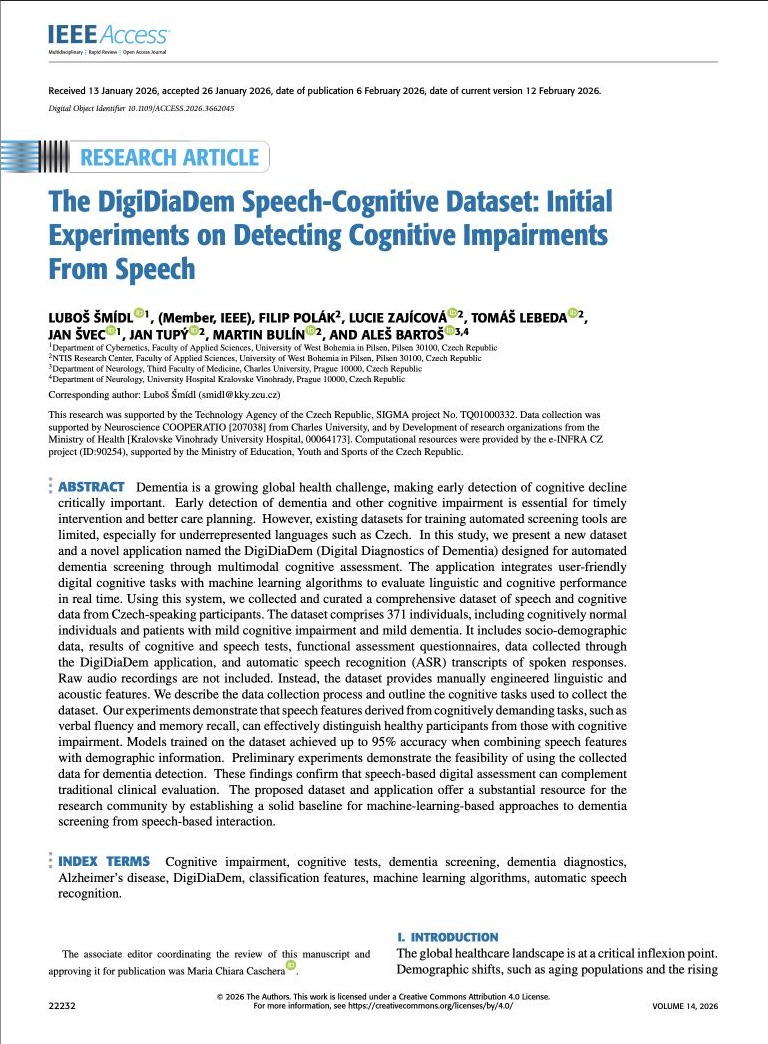
Authors
Luboš Šmídl, Filip Polák, Lucie Zajícová, Tomáš Lebeda, Jan Švec, Jan Tupý, Martin Bulín, Aleš Bartoš
Abstract
Dementia is a growing global health challenge, making early detection of cognitive decline critically important. Early detection of dementia and other cognitive impairment is essential for timely intervention and better care planning. However, existing datasets for training automated screening tools are limited, especially for underrepresented languages such as Czech. In this study, we present a new dataset and a novel application named the DigiDiaDem (Digital Diagnostics of Dementia) designed for automated dementia screening through multimodal cognitive assessment. The application integrates user-friendly digital cognitive tasks with machine learning algorithms to evaluate linguistic and cognitive performance in real time. Using this system, we collected and curated a comprehensive dataset of speech and cognitive data from Czech-speaking participants. The dataset comprises 371 individuals, including cognitively normal individuals and patients with mild cognitive impairment and mild dementia. It includes socio-demographic data, results of cognitive and speech tests, functional assessment questionnaires, data collected through the DigiDiaDem application, and automatic speech recognition (ASR) transcripts of spoken responses. Raw audio recordings are not included. Instead, the dataset provides manually engineered linguistic and acoustic features. We describe the data collection process and outline the cognitive tasks used to collect the dataset. Our experiments demonstrate that speech features derived from cognitively demanding tasks, such as verbal fluency and memory recall, can effectively distinguish healthy participants from those with cognitive impairment. Models trained on the dataset achieved up to 95% accuracy when combining speech features with demographic information. Preliminary experiments demonstrate the feasibility of using the collected data for dementia detection. These findings confirm that speech-based digital assessment can complement traditional clinical evaluation. The proposed dataset and application offer a substantial resource for the research community by establishing a solid baseline for machine-learning-based approaches to dementia screening from speech-based interaction.
Publication links
- DOI: 10.1109/ACCESS.2026.3662045
- Diadem Speech-Cognitive Dataset (DSCD-CZ): Persistent LINDAT/CLARIAH-CZ repository record for the dataset used in the research.